Jumat, 04 Mei 2012

Parapornal activity #FdAdFriday

Horror hides in a box of porn...

Remember last Christmas, when Acart Communications did that Paranormal Activity spoof? We weren't the first to parody the horror franchise, and we won't be the last.

But I don't think anyone will ever make a weirder one than this:


This trailer was made to attract attention to Christian "Comedian*" Rich Praytor's campaign to make his big idea — of combining borrowed interest from Paranormal Activity, Poltergeist and other pop memes, bad jokes, and a morality play about pornography — into a feature film.

According to the Kickstarter page:
Why are we doing a project like this?     
Because films are not only entertaining but they're also a way to teach people.  Society learns their morals and values through music, film and television.  Pornography is such a huge problem that simply telling someone how dangerous it is usually doesn't work.  You have to tell a compelling story to catch someone's attention and then educate them while they're being entertained.  


Praytor promises to let big donors actually take part in the making of the film: For $250, you can "be apart [sic] of a creative brainstorming session with the cast and crew via Skype or in person (transportation not included)"; for $500, they'll name a character after you; for $3500, they'll fly you  to Colorado Springs to direct one of four scenes created from your ideas; $5000 gets you the Executive Producer credit.

But the best deal is the $7500 option:
"The director and two actors will travel to your location (continental United States only) for the day and shoot a scene you created. You will also direct the scene and spend the day with the team."
The subversive potential of being able to write and direct a scene in a low-budget Christian comedo-horror almost seems worth the money.

*And why did I put "comedian" in quotes?

Here is some of Praytor's earlier Christian comedy gold:


Tip via Buzzfeed

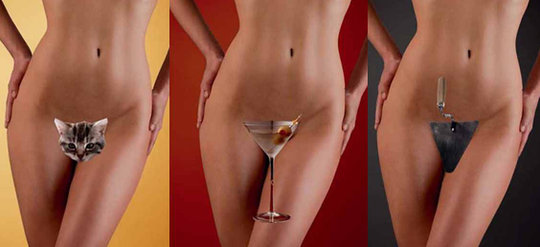
Does "pussy" have the same connotation in Estonian? #FdAdFriday


Without the benefit of Google Translate, my guess is "yes"

Via Copyranter, who notes that Elu24 is the country's largest newspaper.

It's part of a pudenda-obsessed poster campaign which, (this time with the help of Google Translate) is apparently causing quite a bit of controversy.

The martini and the trowel, apparently, do not translate...

Rabu, 02 Mei 2012

Ford's cane toad snuff porn ad: would PETA approve?

I left out "autoerotic bukkake"

So this is a little weird. But give JWT Melbourne the benefit of some context: cane toads are a blight on their land.


But will it sell cars?

Adverblog quoted a YouTube comment, “Entertaining but I know more now about frog secretion then I do about the new falcon.”

Still, I enjoyed it. I guess I'm just perverted that way.

Safer sex billboard versus fretful mother

AdFreak has a story about how a resident of Van Nuys, California, successfully lobbied to have a safer sex billboard in her community taken down from a public thoroughfare. 

The ad in question?

Via KTLA
According to local news outlet KTLA:

"Eve Ragsdale worried about having to explain the billboard to her 6-year-old triplets. 
... 
Ragsdale had contended that her children, who read now and ask questions about everything, were not developmentally ready to have the AIDS-condom relationship explained to them. 
'It's just an inappropriate image for all of the children in the neighborhood,' she said."
I am raising a young child in an urban environment, too. He's also a kid who is curious about everything, but he rarely asks awkward questions about the condoms we see on the sidewalk, or the streetwalkers we drive past. It's not that he doesn't notice. He just doesn't care much about those things at his age.

But as a 7-year-old obsessed with nature, he knows what sex is. (He surprised an after school caregiver last year by pointing out two "mating" squirrels.) If he asked me straight out what a condom was for, I'd tell him in an age-appropriate manner. Even though young ones don't yet have those feelings, it won't be long. My belief is that it's better to normalize condom use before the occasion... arises?

But, of course, other parents may have different views. My major concern here is a very important public health massage being stifled by an individual's feeling that it is not appropriate for the public media. And the media company, who decided to take the knee-jerk approach, gave in without so much as a second thought.

According to the LA Daily News:

"Van Wagner Outdoor Vice Chairman Bill Crabtree told the Daily News that the billboard would be changed on Wednesday or Thursday. 
'I told my operations manager to move it,' Crabtree said. 'We listened to (Ragsdale), we don't necessarily agree with her, but if it's offensive to her, the last thing we want to do is offend anyone.' 
'We don't put up (ads for) strip clubs, we don't put up anything that is lewd," Crabtree explained. "But the AIDS thing is educational, quite frankly. I know people might look at some of the designs askew, but they're trying to get their point across.' 
'We don't put up ads for strip clubs, we don't put up anything that is lewd,' Crabtree said."
 Ironically, as AdFreak's David Kiefaber points out, Van Nuys is literally The Porn Capital of The World. And a recent LA law requires all adult performers to wear condoms in their onscreen couplings.


But hey, Ms. Ragsdale. Heaven forbid you should have to explain that billboard to your children.

If I were the AHF, I would not take this lying down.

The mindless tyranny of the "Rule of Three"


We are all obsessed with threes. Blame School House Rock. (That, and centuries of myth and numerology.)

Ever since I began my career in advertising, the number 3 has been a pain in my creative ass — particularly when it comes to print campaigns. We sit down to brainstorm a campaign, and unless it's a one-off, we always feel compelled to try and make three equally awesome versions of the same "big idea".

The first one is usually great. The second can be also. But the third — that extra push to make it a nice, round numbered campaign — is too often a compromise.

I believe this obsession with three execution print campaigns is universal. I see it all the time in places like Ads of The World, where agencies try to clone one or two good ideas into a "full campaign".

Here is a perfect example:


Some very creative people at  DDB, Sydney, Australia, came up with a clever (if gory) visual idea to communicate the dangers of crossing the road with earbuds on. It's a little shocking for my taste, but it is original (as far as I know) and the execution is solid.

But is it "campaignable?" is always the Creative Director's question. They most likely then looked into other deathly representations of various types of headphones and other peripherals for music players and smartphones.

But what did they come back with?


The same... bloody... ad. But with a man.

What a waste of photography and art direction to duplicate the first idea. (I don't actually know in which order these were conceived, but stay with me here.)

I understand that sometimes clients feel that viewers cannot identify with a person in an ad who is not like them — sexually, ethnically, age-wise or whatever — but I would have argued that the concept was strong enough to overcome that. And the duplication just dilutes the "wow" factor of the original.

But they kept going:


There. Now we've increased the age and ethnic diversity of the campaign. But at this point, I don't even process the concept anymore. I just think that the creative team stubbornly stuck to the one good idea they could come up with.

Damn Rule of Three. It totally ruined an otherwise impressive campaign.

Selasa, 01 Mei 2012

Dove provides yet another new perspective on beauty

Dove Canada would like you to think twice about your perception of beauty. 

According to their Newswire release, the ads "spark a conversation around how extreme re-touching of images can go unnoticed and can distort a woman's perception of beauty." 

It also adds, "ATTENTION PHOTO EDITORS:  Image provided should be run upside down to deliver full impact of campaign."

But since turning non-mobile computers upside down to decode a print ad is rather awkward, here it is:

Her eyes and mouth had been digitally flipped so that they looked normal when you saw them upside down, but when you turned... yikes!


Inversion illusions are not new to advertising, and were once even used to make dirty jokes:


Here's an example of the same trick: (You may recognize the smile)


Dove's campaign leads to  their Canadian Facebook page, where they hope to engage girls in a more positive discussion about beauty. "The Real Truth About Beauty Research",  conducted by Dove, found that only 9% of Canadian girls (10-17) and 3% of women are comfortable calling themselves beautiful.

And to add a little cross-mojination to my blog, here's that ad run through the Ugly Meter I blogged about earlier:


Oh, my!

Beauty and the beastly business of quantifying it

The speed and temporary nature of social media feeds lead to some interesting contrasts.

In my Facebook newsfeed yesterday, I first took note of a Design Taxi link posted by Marc from Osocio about "The World’s Scientifically Most Beautiful Woman".

Here she is:


18-year-old student Florence Colgate has the most naturally perfect face, according to a British lifestyle show's nationwide search.
“Florence has all the classic signs of beauty,” Carmen Lefèvre, of The Perception Lab at the University of St Andrews’ School of Psychology, told The Daily Mail. “She has large eyes, high cheekbones, full lips and a fair complexion. Symmetry appears to be a very important cue to attractiveness.”
Along with — apparently — blonde hair, blue eyes and light, unblemished skin.

I won't even get into the Nordicism of all this. (The Mail actually called her "'Britain's most beautiful face".) There have been enough blogposts about that issue already. I'm more interested in the parts that sociobiologists have tried to rationalize.

For example, symmetry is seen as a sign of good genes and good health. Maladaptive mutations, as well as childhood disease and injury, can affect symmetry. It's seen as a way to advertise good health and disease resistance — in other words, that person is a good source of healthy babies.

The other features are ethnically specific. Blonde hair and big blue eyes are what are known as "neoteny" — that is, babylike features kept into adulthood. All humans are very neotenic apes, retaining our round-headed juvenile chimp features throughout our lives.

Via pbase
The loss of pigment that gave northern people lighter skin is also an adaptive mutation to absorb more vitamin D from less sun exposure. I personally believe that lightening of skin and eyes in parts of those populations came along for the ride, then got amplified by sexual selection because youth is attractive.

But Darwin I ain't.

The other link I was going to mention was actually directly above Marc's "beauty" link. It was a CBC story titled, "Ugly Meter app worries cyber bullying activists"

A smartphone app allows users to assess their own symmetry based on some unknown standards. It's like "Hot or Not", but without the subjectivity of human feedback.

According to uglymeter.net:
"How ugly are you? For over 3 million users, Ugly Meter has been the go-to iPhone App that won’t lie when it comes to determining how attractive or ugly you are. Just snap a picture of yourself (or someone else) in the app and hit the scan button. The Ugly Meter will scan your face and determine just how ugly you are and dispense advice accordingly. Ugly Meter then allows you to post the results to Facebook or Twitter."
I wonder about the ethnic standards of beauty behind this, too. Although my own northern Euro ancestry doesn't seem to have helped much:

I blame the lighting.
I tried a few more times, and found that the insults got pretty creative.

To test the baseline, I tried scanning a screenshot of Miss Colgate:


Clearly, the creators of this app and the people behind the British talent search read the same books. Or something.

But then what happens when I scan a head-on glamour pic of Iman, a woman so ethereally beautiful, she got David Bowie to settle down:


I must have held the camera funny. I'll try again:


Ummm...

But hey, there was nothing scientific about this (mostly because I don't have all day to fart around with my iPhone). If you don't mind giving them your 99¢, you can find out for yourself what "beautiful" really means.

(I'll update this post with more scans, as I get a chance.)


George Clooney (a reader request by Rachel)


Sometimes, it just seems random. Watch what happens when I scanned the face of late-'70s David Bowie, two different times.


Was it the misplaced cursor that made all the difference? (Good thing I didn't shoot him in full Aladdin Sane makeup.)